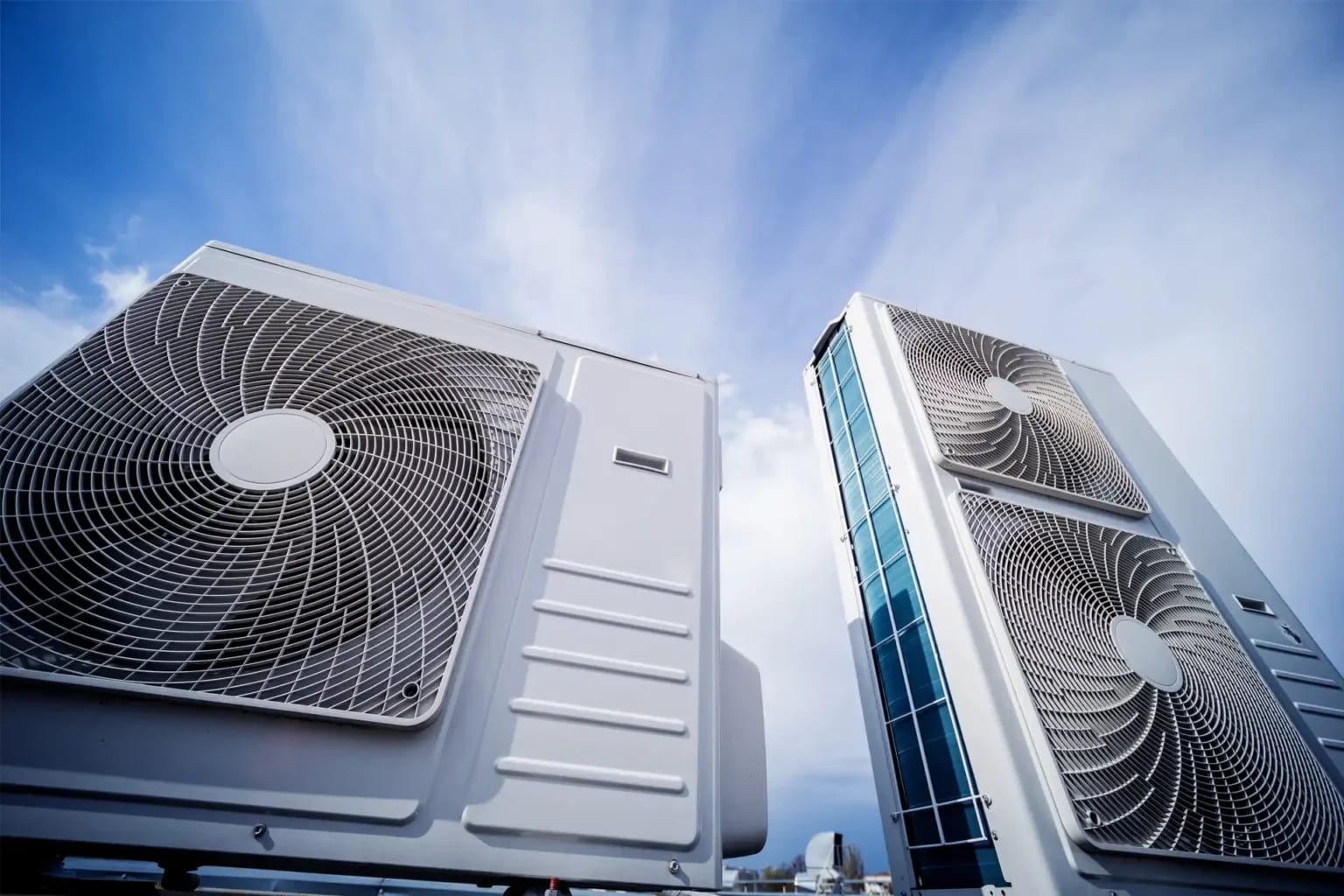
Heat pumps for businesses: lower running costs, steadier comfort, and a credible route to net zero
Heat pumps for businesses are the practical way for an owner-occupier to step off a volatile gas or oil market and onto heating that is cheaper to run, cleaner, and predictable enough to budget around. For most commercial buildings the gas boiler is the single biggest source of carbon, and heat accounts for roughly a third of UK emissions, so replacing ageing combustion plant is where decarbonisation actually starts. A heat pump moves heat rather than burning fuel, delivering three to four units of heat for every unit of electricity, which is the efficiency that turns an unpredictable fuel bill into a heating system you can plan around for two decades. If you own your premises, are watching a boiler near the end of its life, and have a net-zero commitment with no obvious funding behind it, this is the business case worth modelling now.
Why businesses are switching to heat pumps
The pressure points are familiar to any owner-occupier. Gas prices stay volatile and the Climate Change Levy loads extra cost onto fossil fuel, so heating budgets swing year to year with no way to plan them. Boiler plant is ageing toward failure, and a forced replacement is the worst moment to be making a rushed, like-for-like decision. Landlords and occupiers alike face MEES and EPC pressure, and boards have signed net-zero pledges with no clear way to pay for them. A heat pump answers all four at once: it removes on-site combustion entirely (clean Scope 1 evidence for your reporting), it cuts exposure to gas-price swings and the levy, and because the electricity grid keeps decarbonising, the carbon saving improves every year the system runs. For an owner-occupier in for the long haul, that is a heating asset rather than a recurring liability.
How we size and design heat pump systems
We never size from floor area. Heat pump sizing is driven by your building's peak heat-loss and its annual heat-demand profile, so we run a proper heat-loss survey and review at least twelve months of gas or oil consumption before quoting a number. The cardinal rule is to keep the flow temperature low, because every degree of reduced flow temperature lifts the seasonal efficiency, so we design for 45 to 55C wherever the emitters allow, with selective emitter upgrades rather than a full strip-out. Air-source (ASHP) is the fastest, lowest-disruption route, no boreholes, with an SCOP typically 3.0 to 4.0, and a commercial system usually lands in the 40 to 500 kW thermal range. Ground-source (GSHP) draws from the stable temperature of the ground through boreholes (typically 100 to 200m deep) in the 50 to 1,000 kW thermal band, holding an SCOP often above 4.0 all year and offering low-cost summer cooling, ideal for year-round buildings. We specify performance to BS EN 14825 (SCOP) and BS EN 14511 (rated COP) so the figures you receive are directly comparable to any other compliant supplier.
Costs, payback and tax relief
A commercial air-source project typically runs £60,000 to £600,000 with a simple payback near 8 years; ground-source carries higher capital at £150,000 to £2,000,000 and beyond because of the drilling, with payback near 11 years on a self-funded basis. For an owner-occupier the capital tax relief is the biggest lever, since heat pumps rank as plant and machinery. Full expensing lets a corporation-tax-paying company take a 100% first-year deduction with no ceiling, a relief made permanent from April 2026 that hands back up to 25p in tax for each pound spent at the 25% rate. The route for sole traders and partnerships is instead the Annual Investment Allowance, covering up to £1m of qualifying spend at 100%. Because wiring and ancillary works can fall outside full expensing while usually remaining eligible for the AIA, always check the exact treatment with your accountant. Our cost guide sets out worked numbers in full.
Funding routes for commercial heat pumps
Businesses frequently ask about the headline £7,500 grant, so let us be clear: the Boiler Upgrade Scheme is domestic-only and does nothing for a commercial building. The funding playbook for an owner-occupier is different and, often, larger. Public-sector bodies, NHS trusts, schools, colleges, universities, local authorities and emergency services should look first at the Public Sector Decarbonisation Scheme administered by Salix for DESNZ, which funds low-carbon heating over and above a like-for-like fossil replacement through competitive windows. Eligible industrial sites can pursue the Industrial Energy Transformation Fund (typically 30 to 50% intervention, SME minimum grant £75,000) for fuel-switching and waste-heat recovery. Multi-building or campus schemes can draw on the Green Heat Network Fund, up to 50% of eligible costs. Any business can layer full expensing or the Annual Investment Allowance on top. We map which routes you genuinely qualify for and build the application around the project. The full picture is on our grants and funding page.
Compliance and sector considerations
For systems up to 45 kWth, MCS certification (or a recognised commercial equivalent) is required to access most grant routes, and our engineers work to the MCS 025 installer competency standard; above 45 kWth we design to CIBSE and BSRIA standards. All refrigerant handling is carried out by F-Gas certified engineers under the UK F-Gas Regulation, and we design around the refrigerant phase-down, specifying lower-GWP options such as R32 (A2L) and, for high-temperature duties, natural refrigerants like R290. Many commercial air-source installs fall under permitted development but are subject to size, siting and noise limits, so a BS 4142 acoustic assessment is commonly required to show the external unit will not disturb neighbours, and we treat that as standard rather than an extra. Listed buildings and conservation areas need consent, and ground-source borehole arrays may need planning depending on scale (open-loop systems abstracting groundwater need an Environment Agency permit). Large heat pumps add meaningful electrical load, so we confirm DNO supply capacity early, because a supply upgrade can be the longest-lead item in the whole project.
How we approach the project
Our approach removes the two things that have burned commercial buyers before: vague numbers and over-optimistic quotes. We model running cost and carbon from your own consumption data at current and forecast prices, then share the full model so you can stress-test it or get a second opinion. We survey your emitters and pipework first so you do not pay for a strip-out you do not need, check the plant compound, siting and acoustics before we quote rather than on the day, and submit the grid application early where a DNO supply upgrade is needed. On running cost: electricity costs roughly three to four times the unit price of gas, so a heat pump only wins if the SCOP and tariff are right, and an SCOP of 3.5 (3.5 units of heat per unit of electricity) offsets most of that gap. With a low flow temperature and a sensible tariff, well-designed commercial systems are at or below gas running cost today, and the gap widens as gas carbon levies rise. We would rather lose a job to honest maths than win it on a figure we cannot stand behind.
An illustrative example
As an illustrative composite based on a typical owner-occupier retrofit, a 70-bed care home running a pair of ageing gas boilers near failure, with a year-round heating and hot-water demand and rising bills, installed a 180 kW cascaded air-source system of six modular units with selective emitter upgrades and the existing boiler retained for peak backup. It delivered around 360,000 kWh of heat a year at an SCOP near 3.6, cut on-site combustion by roughly 85%, saved in the region of 55 tonnes of CO2 a year, with a payback close to 7.5 years, and full expensing delivered first-year tax relief. The work was scheduled in autumn around the operating calendar with the old boilers kept live through commissioning. The figures are illustrative and depend entirely on your building, heat load, emitters and tariff.
To go deeper, compare commercial air-source heat pumps as the default first move, or read about a lower-capital hybrid boiler-replacement retrofit if your emitters were sized for a hot gas flow. When you are ready, work through the cost guide and funding routes, read the heat pump FAQs, or request a feasibility study built from your own consumption data.